
# Planning Your 2027 Kamado Assortment: Which Sizes Retailers Should Stock by Market
**Build a kamado assortment around three decisions, in this order: your size ladder, how many SKUs you are prepared to carry, and your price tiers. Size comes first because it determines your freight, your display footprint, and who the product is for. A workable assortment is usually three to five sizes — not eight — with one hero SKU carrying your volume, one or two mid-sizes broadening appeal, and one large unit anchoring the top of the range.**
The mistake most importers make is choosing sizes by what looks impressive in a catalogue rather than by the space their customer actually cooks in.
—
## The size ladder
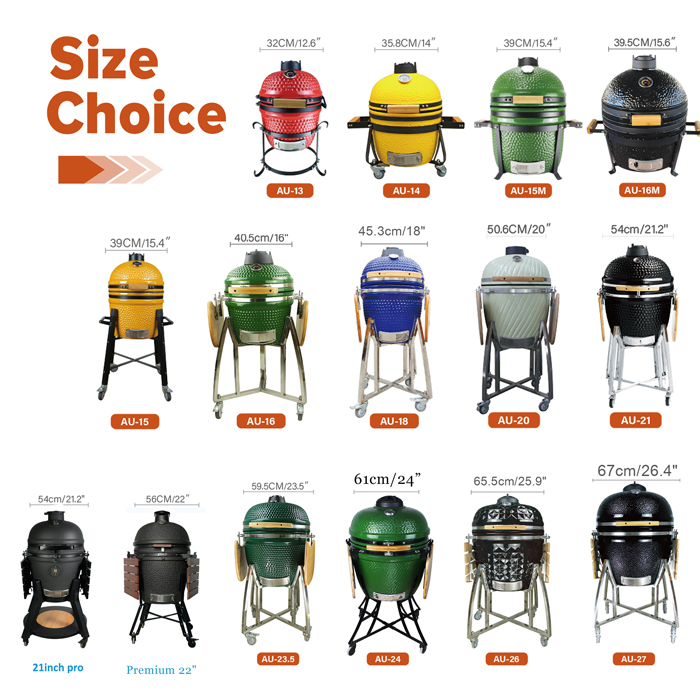
Ceramic kamado grills are specified by body diameter in inches. Our current range runs from 16-inch to 27-inch:
| Size | Positioning | Typical buyer need |
|—|—|—|
| 16″ | Compact / urban | Balconies, small households, couples, first kamado |
| 18″ | Small family | The entry point for most family cooking; strong volume size |
| 21″ | Mid-range | Larger households; the size many buyers trade up to |
| 22″ | Mid-range | Direct comparison with the 21″; check grid diameter, not just body size |
| 23″ | Mid-plus | Entertaining, larger families, premium carts |
| 27″ (Pro Series XXLarge) | Flagship | Serious entertainers, premium retail, statement display piece |
Two cautions when reading this ladder:
- **Adjacent sizes compete with each other.** A 21-inch and a 22-inch unit sit close enough that most customers will not own both — they will choose. Stocking both only makes sense if they are differentiated by finish, cart or price tier.
- **Compare cooking grid diameter, not body diameter.** Two grills with the same body size can have noticeably different usable cooking area.
—
## Matching sizes to your market
This is a decision that has to be made with your own market data. The questions that determine the answer:
| Question | What it tells you |
|—|—|
| What is the typical household size you serve? | Drives the centre of your ladder — 18″ for smaller households, 23″ for larger |
| How much outdoor space does your customer have? | Balcony and courtyard markets skew small; garden markets support large |
| Which channel are you selling through? | Garden centres display differently from e-commerce; floor space limits SKU count |
| What is your price ceiling? | Large sizes need a customer base willing to pay premium prices |
| What season are you selling into? | Gift and holiday seasons favour compact sizes; spring garden resets favour the mid range |
| Do you sell assembly or cart-based units? | Cart-mounted units suit entertaining-led customers and premium positioning |
Answer these six and your ladder writes itself. Guessing at them is how importers end up with a container of 27-inch units and no customers for them.
—
## How many SKUs do you actually need?
Three to five sizes is the usual working range. A pattern that holds up in most markets:
- **One hero SKU** — your 18-inch or 21-inch, carrying the majority of your volume
- **One or two mid-size SKUs**, differentiated from the hero by finish, cart configuration, or price tier
- **One large size** — anchoring the top of the range and making the mid-size look like good value
- **Optionally one compact size** — for gift seasons, urban markets, or as a price-entry offer
Every additional SKU costs you storage, display space, and working capital. It also fragments your order quantity across more models, which raises your unit cost on each. If you are testing a new size, treat it as a replacement for a weak performer rather than an addition.
—
## Price tiers matter more than size count
A range that is easy to sell has a visible shape: an entry point, a most-popular middle, and a top end. Decide the tiers first, then place sizes into them.
| Tier | Typical role | Size placement |
|—|—|—|
| Entry | Opens the conversation, serves price-sensitive customers | Compact size, standard finish |
| Core | Your volume driver, easiest to sell | 18″–22″, standard or mid-tier cart |
| Premium | Margin and brand positioning | 23″–27″, premium cart, premium finish |
If your range has five sizes all at similar price points, you do not have an assortment — you have inventory.
—
## Testing a new size without overcommitting
You do not need a full container of an untested size. Two approaches work:
**Mixed-size containers.** Combine two or three sizes in one shipment. The unit cost is usually close to a single-model container, provided the carton dimensions are similar and the container still loads efficiently. This lets you test a new size alongside your proven ones.
**Size the shipment against the loading plan.** As a reference point, our 22-inch model loads 54 units in a 20 ft container, 108 in a 40 ft, and 162 in a 40 ft HQ. A mixed container takes proportionally fewer of each model. Ask for a loading plan for your exact mix before you commit — untested mixes are how containers end up shipped short.
—
## Timing your 2027 buying
Work backwards from your selling season rather than forwards from the order:
1. **Fix your on-shelf date** for each tier.
2. **Subtract transit and customs.** This is not part of the production window.
3. **Subtract production** — 20–30 days after deposit and final approval on our standard terms.
4. **Subtract sampling** — about 7 days for samples, plus your own approval time.
5. **Subtract your internal approval and budgeting time**, which is usually the item nobody accounts for.
Buyers who plan from the order date discover they are late. Buyers who plan from the shelf date arrive on time.
—
## Five assortment mistakes worth avoiding
1. **Too many adjacent sizes.** Two sizes within an inch of each other compete for the same customer.
2. **Skipping the compact size.** Without an entry size, your cheapest option is your mid-size, which caps how price-sensitive a customer you can serve.
3. **Under-stocking the hero.** Volume concentrates in one size. Running out of it mid-season costs more than any other stock position.
4. **Forgetting accessories.** Covers, tools, and side shelves attach to the same order and carry good margin with almost no additional freight planning.
5. **Customising before the assortment is proven.** Custom colours and packaging raise minimums. Prove the sizes first, then customise.
—
## Frequently asked questions
**How many kamado grill sizes should a retailer stock?**
Usually three to five. One hero size for volume, one or two mid-sizes for breadth, and one large size for range anchoring. More than five is usually range padding rather than range building.
**What size kamado is best for a first-time buyer?**
An 18-inch unit suits most first-time buyers with a small family. A 16-inch unit suits balcony, courtyard, and small-household markets, and works well as an entry price point.
**Is 21-inch or 22-inch better?**
They are close enough that most customers will choose one rather than own both. Compare cooking grid diameter rather than body diameter, and differentiate them by cart or finish if you stock both.
**What is the largest size worth stocking?**
Large units in the 23–27-inch range suit entertaining-led and premium customers. They need a customer base willing to pay premium prices and enough display floor space — both are real constraints in general retail.
**Can I stock a new size without ordering a full container?**
Yes. Mixed-size containers are standard practice and the unit cost is usually close to a single-model container if the carton dimensions are similar. Ask for a loading plan for your specific mix.
**How far ahead should I place a 2027 order?**
Work backwards from your on-shelf date: subtract transit and customs, production time (20–30 days after deposit and final approval on our terms), sampling (about 7 days), and your own approval time. Most importers underestimate the last item.
**Do I need custom colours to differentiate my range?**
Not initially. Standard colours are already available in black, red and green, and custom colours raise your minimum because they require separate kiln scheduling. Prove the sizes first.
—
## Build your 2027 ladder with real loading data
Send us the sizes you are considering and the channels you sell into, and we will come back with carton dimensions, loading quantities per container, and a mixed-loading plan for your proposed range. Email **vivian@auplexbbq.com** or use our [contact form](https://www.auplexbbq.com/contact-us/). Specifications per model are on the [grill page](https://www.auplexbbq.com/grill/), and lead times are covered in our [FAQ](https://www.auplexbbq.com/faqs/).
—
**Author**
Auplex Export Team — Fujian Auplex Kamado Grill Co., Ltd.
Ceramic kamado grill manufacturing since 2010 · Minhou, Fuzhou, Fujian, China
[www.auplexbbq.com](https://www.auplexbbq.com/)
Post time: Sep-09-2026