
# Kamado Grill Certifications for the EU and North America: What EN 1860, LFGB and BSCI Actually Cover
**The names on a supplier’s certificate list are not equivalent, and asking “do you have certification?” produces a meaningless answer. They fall into four different categories: product safety standards, food-contact and material safety requirements, social compliance audits, and test-house reports. EN 1860-1 covers how a solid-fuel barbecue performs and is built. LFGB and FDA address food-contact safety. BSCI audits a factory’s labour and management systems. “SGS” is not a standard at all — it is a testing company, and what matters is which test report they issued.**
If you are buying for the EU or North America, you need documents from at least two of those categories, and they answer entirely different questions.
—
## The four categories, side by side
| Document | Category | What it addresses | What it does **not** prove |
|—|—|—|—|
| **EN 1860-1** | Product safety standard | Requirements and test methods for barbecues burning solid fuels — materials, construction | Does not cover electrical safety, and does not apply to single-use barbecues |
| **LFGB** | Food-contact / consumer goods law | Materials in contact with food, and articles in contact with the human body | Not a factory audit; not a product-performance standard |
| **FDA (food-contact)** | Food-contact requirements | Materials intended for food contact under US rules | Not an EU route to compliance, and not an appliance safety approval |
| **BSCI (amfori)** | Social compliance audit | Labour, working conditions, and management systems at the factory | Says nothing about product quality, materials, or performance |
| **CE marking** | Market-access marking | Whatever EU directive or regulation applies to the product, declared by the manufacturer | Not a certification issued by anyone; it is a manufacturer’s declaration |
| **SGS** | Testing / inspection house | Whatever specific test it was engaged to perform | Issuing the report does not make the product compliant with anything by itself |
The practical takeaway: **ask which document covers which question.** A supplier who answers a product-safety question with a social-audit certificate is not lying, but you are not getting what you asked for.
—
## EN 1860-1: the product side
EN 1860-1 is the European standard for barbecues that burn solid fuels. As published by national standards bodies, it specifies requirements for such barbecues with regard to materials and construction, together with the relevant test methods — and it is applicable to barbecues burning solid fuels, excluding single-use barbecues.
For a ceramic kamado, that is the relevant product standard, because a kamado is a solid-fuel barbecue.
**What to request:** the test report, not the logo. Ask which edition of the standard was applied and the date of the report — standards are revised, and an old report may reference a superseded edition. Ask also which specific components were tested.
**What it does not give you:** it is not an appliance safety approval covering electrical parts, and it does not address social or environmental performance at the factory.
—
## LFGB: the food-contact side
LFGB is German food and consumer goods law covering the safety requirements for food-contact materials and related consumer products. Its scope extends beyond items that touch food to include articles that come into contact with the human body.
Why it matters for a kamado: the cooking grid and any part of the cooker that touches food are food-contact surfaces. The registration of your product in the German market, and the confidence of your retail buyers, both rest on that material evidence.
**What to request:** the test report, including which materials were tested (for example the cooking grid’s stainless steel) and which migration or material criteria were applied.
**What it does not give you:** it is not a statement about whether the grill performs well, and it is not a factory audit.
—
## FDA: the North American side
For the United States, the relevant question for a barbecue is usually about food-contact materials rather than appliance safety certification. The FDA administers the food-contact requirements; “FDA compliant” in a supplier’s marketing typically means the food-contact materials were assessed against those requirements.
**What to request:** specify which materials you need covered, and ask for the underlying test data rather than a compliance statement. Note that food-contact compliance for the US is a separate exercise from the EU route — one does not substitute for the other.
—
## BSCI: the factory side
BSCI is an amfori social compliance audit. It assesses a factory’s labour practices, working conditions, and management systems. It is a **social** audit, not a product standard.
This is the single most common category error in supplier certificates. A buyer asks about product safety, receives a BSCI report, and believes the product has been “certified”. It has not — what has been verified is that the factory’s systems meet a social compliance standard.
That is valuable, particularly if you supply retail chains that require it. It is simply a different question.
**What to request:** the audit report, the audit date, and the audit grade — reports expire, and a three-year-old report describes a factory that may have changed.
—
## CE marking and “SGS”: two common confusions
**CE marking is not a certificate.** It is a manufacturer’s declaration that the product meets the applicable EU requirements. For a solid-fuel barbecue, ask which directive or regulation the declaration refers to, and request the declaration of conformity. Nobody “issues” CE.
**SGS is a testing and inspection company, not a standard.** A supplier listing “SGS” is telling you which company ran a test, not what was tested or against which standard. Ask for the report and read its scope line.
—
## The document request list
Copy this into your supplier questionnaire:
1. For each product standard claimed: the **test report**, the edition of the standard applied, the report date, and the components covered.
2. For food-contact claims: the **materials tested**, the criteria applied, and the report.
3. For social audits: the **audit report**, the audit body, the date, and the grade.
4. For CE: the applicable directive or regulation, and the **declaration of conformity**.
5. For any third-party test: the **scope line** of the report — what exactly was tested.
6. For all of the above: **validity dates**, and confirmation that the named product is within the report’s scope.
Two habits make this work. First, ask for documents rather than assurances. Second, check that the product you are ordering is actually inside the scope of the report — a report covering one model does not automatically cover the whole range.
—
## How we approach documentation
Our factory holds BSCI, FDA, LFGB, CE and SGS documentation, and our product sheets list LFGB, BSCI, EN-1860, BACT and SCS. Our processes have passed factory inspections for international retail chains including COSTCO, MGB, BUNNINGS and CTC, which audit their suppliers before placing volume.
If you send us your destination market, we will tell you which documents we can provide for the models you are considering — and which requirements sit with you as the importer. Reach us at **vivian@auplexbbq.com** or through our [contact form](https://www.auplexbbq.com/contact-us/). Company background is on the [About Us page](https://www.auplexbbq.com/about-us/).
—
## Frequently asked questions
**What is the difference between EN 1860 and BSCI?**
EN 1860-1 is a product standard for barbecues burning solid fuels, covering materials, construction and test methods. BSCI is a social compliance audit of the factory’s labour and management systems. One is about the product; the other is about the workplace.
**Is LFGB a certificate I can be issued?**
LFGB is German food and consumer goods law, not a certificate. What you receive is a test report showing that specified materials were tested against the applicable requirements. Ask for the report and the materials it covers.
**Do I need both FDA and LFGB?**
They serve different markets — LFGB relates to German/EU requirements, FDA to US food-contact requirements. Which you need depends on where you sell. One does not substitute for the other.
**Does CE marking mean the product is certified?**
No. CE is a manufacturer’s declaration of conformity with the applicable EU requirements, not a certificate issued by a body. Ask which directive or regulation it refers to and request the declaration.
**What does a BSCI audit grade tell me?**
It reflects how the factory performed against the social compliance criteria at the time of the audit — labour practices, working conditions, and management systems. It tells you nothing about product quality or materials.
**Does a product certificate cover the whole range?**
Not automatically. Test reports have a scope, and a report covering one model does not necessarily cover others. Always check that the model you are ordering falls within the report’s scope.
**Do certificates expire?**
Test reports and audit reports both have validity periods, and standards are revised. Always check the date and the edition referenced, and re-request documents if either is old.
**Who is responsible for compliance in my market?**
In most markets the importer carries the responsibility for placing a compliant product on the market. Your supplier provides documentation; the importer’s obligations are yours to meet.
—
## Sources and scope note
The descriptions of EN 1860-1 and LFGB above are summarised from the published titles and scope statements of those standards and laws as listed by national standards bodies and compliance organisations. Standards and regulations are revised; **confirm the current edition and its applicability with the issuing standards body or your compliance advisor before relying on it for a shipment.** The BSCI description reflects its nature as an amfori social compliance audit.
—
**Author**
Auplex Export Team — Fujian Auplex Kamado Grill Co., Ltd.
Ceramic kamado grill manufacturing since 2010 · Minhou, Fuzhou, Fujian, China
[www.auplexbbq.com](https://www.auplexbbq.com/)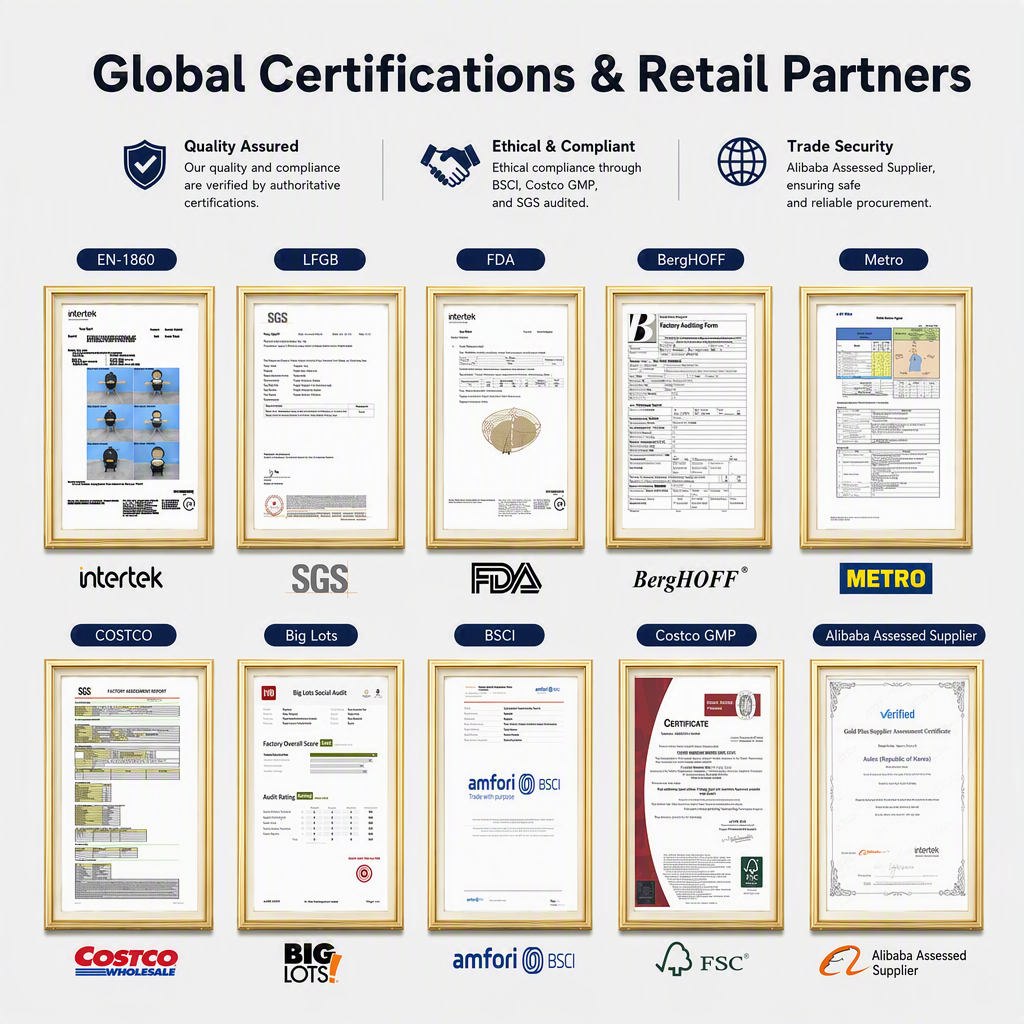
Post time: Sep-08-2026