
Gas vs Briquette Charcoal vs Ceramic Charcoal Grills: Full Comparison
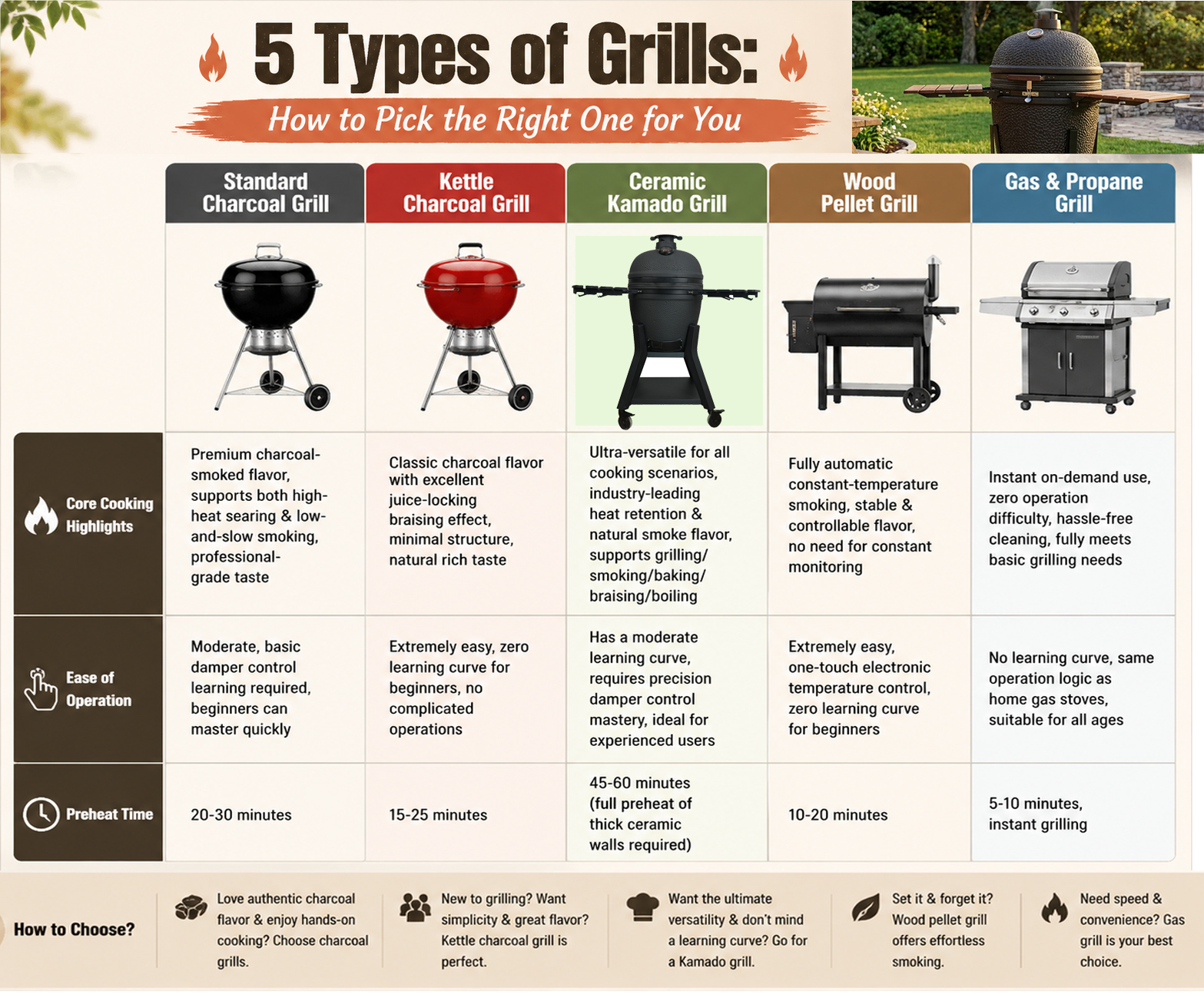
Choosing an outdoor grill depends on your available space, flavor preference, budget, and lifestyle. Gas, briquette charcoal, and ceramic charcoal grills are the three most popular backyard grilling options. Each delivers distinct performance, pros, and tradeoffs to suit different users.
Gas Grills
Advantages
Gas grills are the most convenient and user-friendly option for everyday outdoor cooking. They feature fast startup and shutdown, precise temperature control, and low ongoing operating costs. Most models come with multiple burners, warming zones, side shelves, and support versatile accessories like rotisserie attachments to expand cooking functions.
Cleaning and routine maintenance are simple, with only cast iron grates requiring extra care. Built with durable stainless steel, gas grills offer a sleek outdoor aesthetic. Quality residential units range from $500–$1,500, with upgraded commercial-grade models available for heavy-duty use.
Limitations
Gas grills produce a milder flavor compared to charcoal grills, lacking authentic smoky charred notes. Standard gas grills have a relatively large footprint, making them less ideal for small patios and balconies.
Users may run out of gas mid-cook without prior tank checks. The all-metal body heats up intensely during use, creating burn risks. Strong radiant heat strips food moisture easily, often resulting in dry meat, especially chicken breast.
Briquette Charcoal Grills
Advantages
Briquette charcoal grills deliver classic charcoal flavor at an affordable price point. Entry-level models start at $20, with standard quality options priced $75–$150. Briquette charcoal is widely available in multiple varieties, including quick-light and mesquite-flavored options.
They offer a spacious cooking area for both direct and indirect grilling. Adjustable vents enable basic smoking functions for richer flavors. Their compact build works well for users with limited outdoor space.
Limitations
These grills require a long preheat time of 20–30 minutes. Most basic versions lack built-in thermometers, forcing temperature guesswork and leading to inconsistent cooking results.
The metal structure heats up drastically and poses burn hazards. Intense radiant heat accelerates moisture loss, which can leave grilled foods dry and tough without careful monitoring.
Ceramic Charcoal Grills
Advantages
Designed for flavor-focused grill enthusiasts, ceramic charcoal grills deliver superior smoky charcoal taste with excellent moisture retention. The high-density ceramic shell provides stable, even heat, keeping meats tender and juicy.
Ultra-versatile, they feature a wide temperature range from 225°F for low-and-slow smoking to over 750°F for high-heat searing, serving as a grill, oven, and smoker in one. Quick 15-minute preheating ensures efficiency. Compact in size, they fit most backyards and support a full range of accessories, priced $850–$1,000.
Limitations
Beginners face a slight learning curve to master airflow and temperature control. Weighing around 150 lbs, the heavy build makes movement and installation cumbersome. While heat-resistant, the ceramic shell can chip or crack under strong impact or rough handling.
Post time: Jun-28-2026